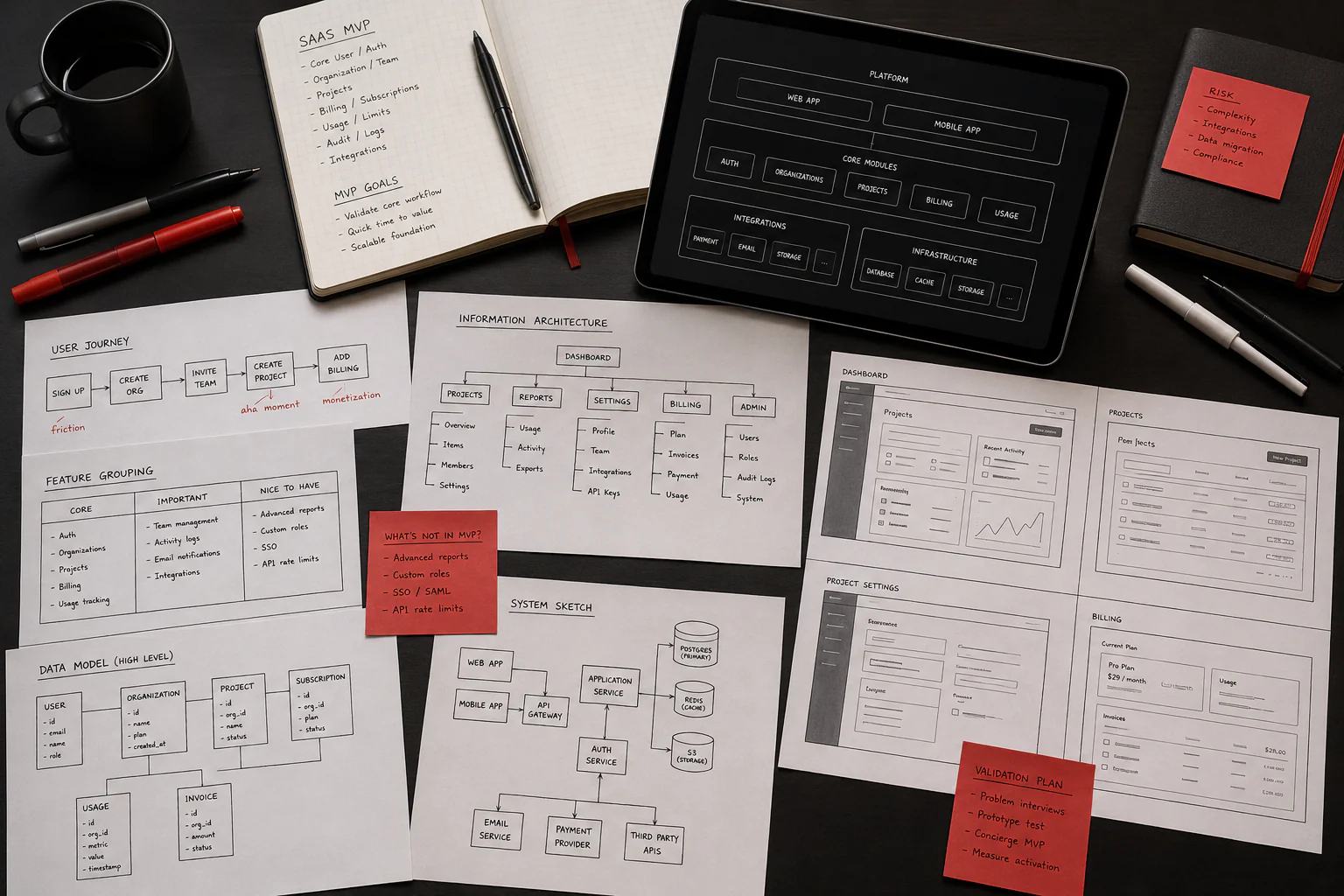
SaaS development planning is the process of defining users, roles, features, billing, integrations, and launch scope before engineering starts. Planning before development helps you define who the product serves, what the first release must do, and which architectural decisions will be expensive to change later.
SaaS development planning is the process of defining users, roles, features, billing, integrations, and launch scope before engineering starts. It turns a product idea into a buildable scope document that engineering, design, and operations can align on.
Useful planning starts with a single primary workflow. For SaaS development, that workflow becomes the backbone for onboarding, permissions, the data model, and the admin tools your team needs on day one.
SaaS projects fail early when teams build before clarifying product logic. Common failure patterns include adding billing after screens are designed, discovering multi-tenant rules mid-build, or launching without admin and support tooling.
Every SaaS product has at least two perspectives: the person using the product day to day and the person approving budget or renewal. Their goals are not always the same. Document the core job the product must complete in the first session and the outcome that makes renewal logical.
Multi-sided products add more role types. PrestoEat, a food and grocery delivery platform iCodeLTD supported, connects customers, restaurants, grocery vendors, riders, and internal operations through a unified digital ecosystem. Each role depends on different workflows, permissions, and operational visibility—making a single-app mindset insufficient for the product.
Roles determine what users can see, create, edit, approve, or export. If you add roles late, you often rework navigation, APIs, and audit behavior. List role types early—owner, admin, member, viewer, billing contact—and note which actions each role requires.
Onboarding should get a new user to first value quickly. Decide whether signup is self-serve, invite-only, or sales-assisted, and what minimum profile or organization data is required.
The dashboard should answer one question for the primary user: what do I need to do next? Avoid loading the first release with analytics that require months of data before they become useful.
Even a simple billing model needs clear rules: free trial or not, plan limits, upgrade paths, and what happens when payment fails. Billing decisions affect database design, background jobs, and admin tooling.
Plan structure should match how customers perceive value: seats, usage volume, feature tiers, or workspace limits. Define what happens when a limit is reached—hard stop, grace period, or upgrade prompt—and how billing events sync with product state. Do not copy pricing from competitors; define the billing logic your product needs and integrate with a billing provider that supports it.
Sendmatico, an iCodeLTD-owned cold email outreach SaaS, uses usage-based credits with a free tier to start. It illustrates how subscription products can tie product access to measurable usage—campaign sending, lead management, and mailbox connections—without requiring every billing detail to ship in the first engineering sprint.
Admin capabilities often include user management, plan changes, support lookup, and configuration. Decide which admin actions are required at launch versus after validation. Both customer and admin experiences should be planned as part of SaaS delivery—not treated as separate afterthoughts.
For multi-sided platforms, admin tooling also covers operational visibility: order management, vendor or partner workflows, rider coordination, and internal team permissions. PrestoEat required admin tools, backend/API systems, payments, order management, and notifications working together—not only a customer-facing mobile app.
Identify third-party systems required for launch: authentication providers, payment processors, email delivery, analytics, or customer CRMs. Note which integrations are must-have versus post-launch.
Sendmatico connects Gmail, Outlook, and custom SMTP/IMAP mailboxes, and supports webhooks and API access for campaign and reply workflows. That level of integration planning—what connects, what data flows, and what fails gracefully—is typical for SaaS products that depend on external systems.
List the events that trigger email or in-app notifications. For each event, define recipient, channel, and whether the user can opt out. Delivery platforms such as PrestoEat rely on push notifications, order updates, and operational alerts across customers, vendors, and riders—each with different timing and permission rules.
Define what the product team and customers need to see at launch versus later. Early analytics should support the core workflow—usage of key features, activation milestones, and error visibility—not a full business intelligence suite.
A lightweight architecture document should describe core entities, relationships, tenant boundaries, and the main API boundaries. This does not need to be exhaustive, but it should prevent obvious rework—such as discovering multi-tenant rules after screens are built.
Teams planning a first SaaS release with startup product development support often map entities, permissions, and integration touchpoints before UI design is finalized.
iCodeLTD helps teams plan, build, and improve SaaS products with attention to multi-tenant structure, onboarding, admin tooling, billing integration, and the operational needs of subscription businesses.
Typical SaaS development process steps include discovery and scope, architecture planning, design and development, testing and launch, and iteration as the product grows. Discovery clarifies product goals, customer types, account structure, and core workflows for the first release. Architecture planning defines tenancy, roles, data models, billing hooks, APIs, and admin operations before implementation.
For early-stage teams, startup product development combines product discovery, focused MVP engineering, and technical choices that preserve room for future growth—without overbuilding before validation.
Plan users and roles, the core workflow, MVP feature boundaries, billing logic, admin tooling, integrations, notifications, basic analytics, and launch support. These decisions shape backend structure and are expensive to change after build starts.
Include only what is required for a new user to complete the primary workflow and for your team to operate and support the product. Defer advanced reporting, complex role hierarchies, and integration marketplaces until the core workflow is validated.
You need billing logic defined even if full self-serve checkout comes later. Decide plan limits, trial rules, upgrade paths, and how product access responds to payment status. Billing hooks affect database design and admin tooling from the start.
A scope document should list user types, roles, MVP modules, billing rules, integrations, admin requirements, notification events, analytics needs, security and tenancy rules, and launch support expectations. It should be detailed enough for engineering estimates without prescribing every UI detail.
Roles control navigation, API access, audit behavior, and admin capabilities. Adding roles late often forces rework across screens, backend services, and support workflows—especially in multi-tenant or multi-sided products.
iCodeLTD can clarify product goals, account structure, and core workflows through discovery, then define architecture, billing hooks, and admin operations before implementation. Plan your SaaS build to review scope, architecture, and delivery phases.
Use the project cost calculator to explore scope categories for your SaaS MVP, then book a strategy call to pressure-test your plan before development starts.
SaaS Development
SaaS Data Security Basics for Startups: What Founders Should Get Right Before Launch
What founders should get right before launch: tenant data separation, per-request authorisation, login protection, secrets, webhook verification, backups, and audit records — based on OWASP guidance and Stripe docs.
Read moreAI Solutions
Is Your AI Feature Actually Working? How to Measure AI Performance After Launch
Your AI feature impressed in the demo. Here is how founders define what “working” means and measure it continuously against real usage.
Read moreProduct Delivery
Fixed Price vs Time and Materials: A Founder's Guide to Software Pricing Models
Fixed price or time and materials? Learn how each software pricing model assigns risk, when each one fits a startup project, and what your contract must include either way.
Read moreReady to review scope for AI, SaaS, web, mobile, or automation work?