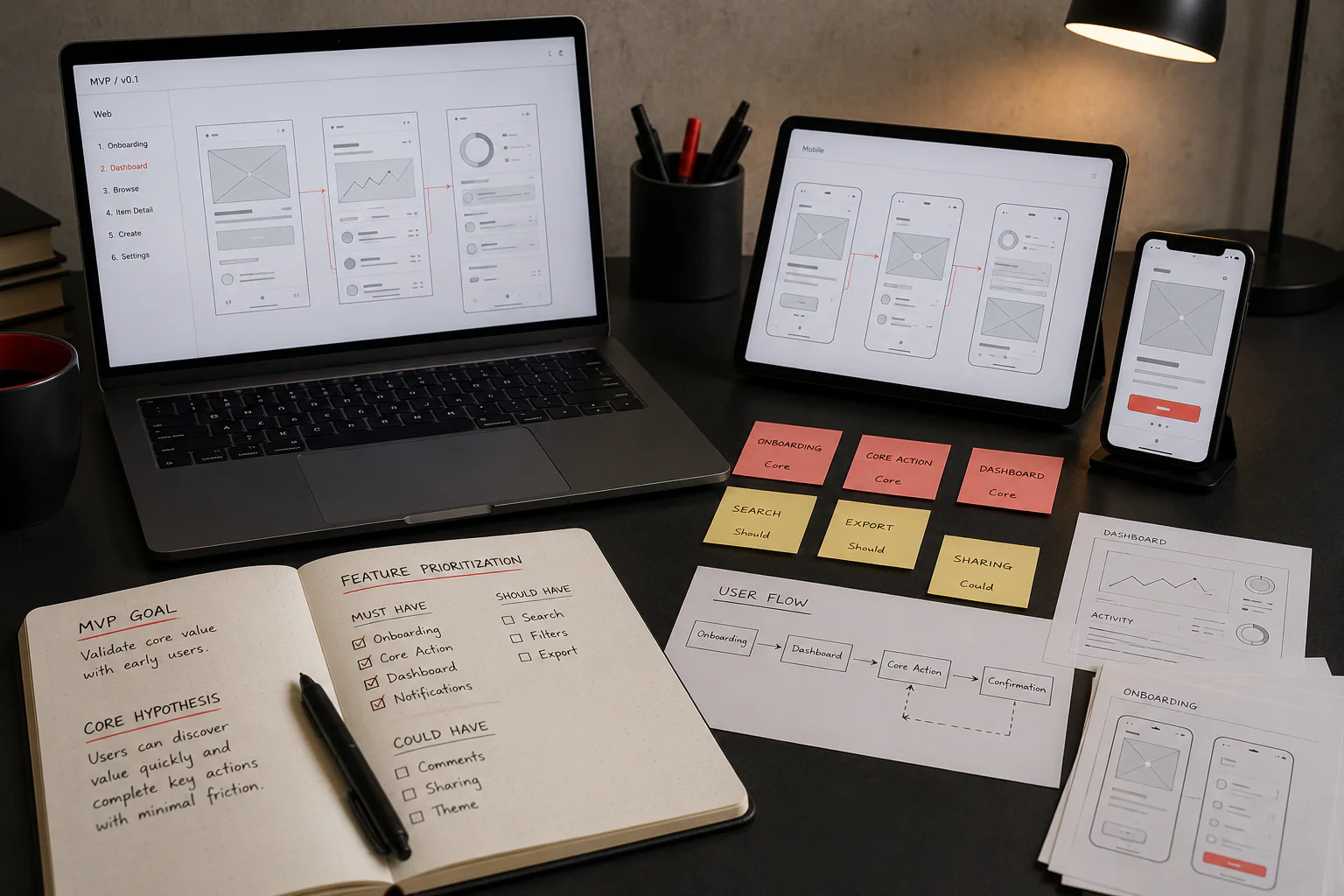

MVP planning is about focus, not building less randomly. A strong first version solves one core problem for one primary user group, runs reliably, and creates a feedback loop that informs what to build next.
Start with the journey that proves your product idea: how a user discovers the product, completes the core action, and receives value. If that journey is not clear, feature lists will expand without direction.
Founders working through startup product development often document this journey as a short flow diagram before writing detailed requirements.
Choose platforms based on context of use. Web is often the fastest path for admin-heavy workflows, dashboards, and products used primarily at a desk. Mobile fits field use, on-the-go access, and experiences that benefit from device capabilities.
If mobile is required for the first test, scope a focused mobile app MVP. If the first release is web-first, plan web app development around the core workflow and defer responsive polish on secondary screens.
Must-have features are required for the core journey to work end to end. Should-have features improve convenience but are not needed to validate the idea. Everything else belongs in a later phase.
Low-fidelity flows and key screens help align stakeholders before engineering begins. Design does not need to be final marketing polish, but it should resolve navigation, empty states, and error handling for the launch journey.
MVP scope often changes when backend needs surface late: authentication, roles, file storage, notifications, payments, or third-party APIs. List backend capabilities required for launch and note which can be manual behind the scenes in version one.
Release one should answer specific questions: Do users complete the core action? Where do they stall? What support requests repeat? Define how feedback is collected and who reviews it weekly.
Use a simple matrix to rank features by user impact and build effort. Keep the first release in the high-impact, feasible zone. Defer features that require large integrations or unclear demand.
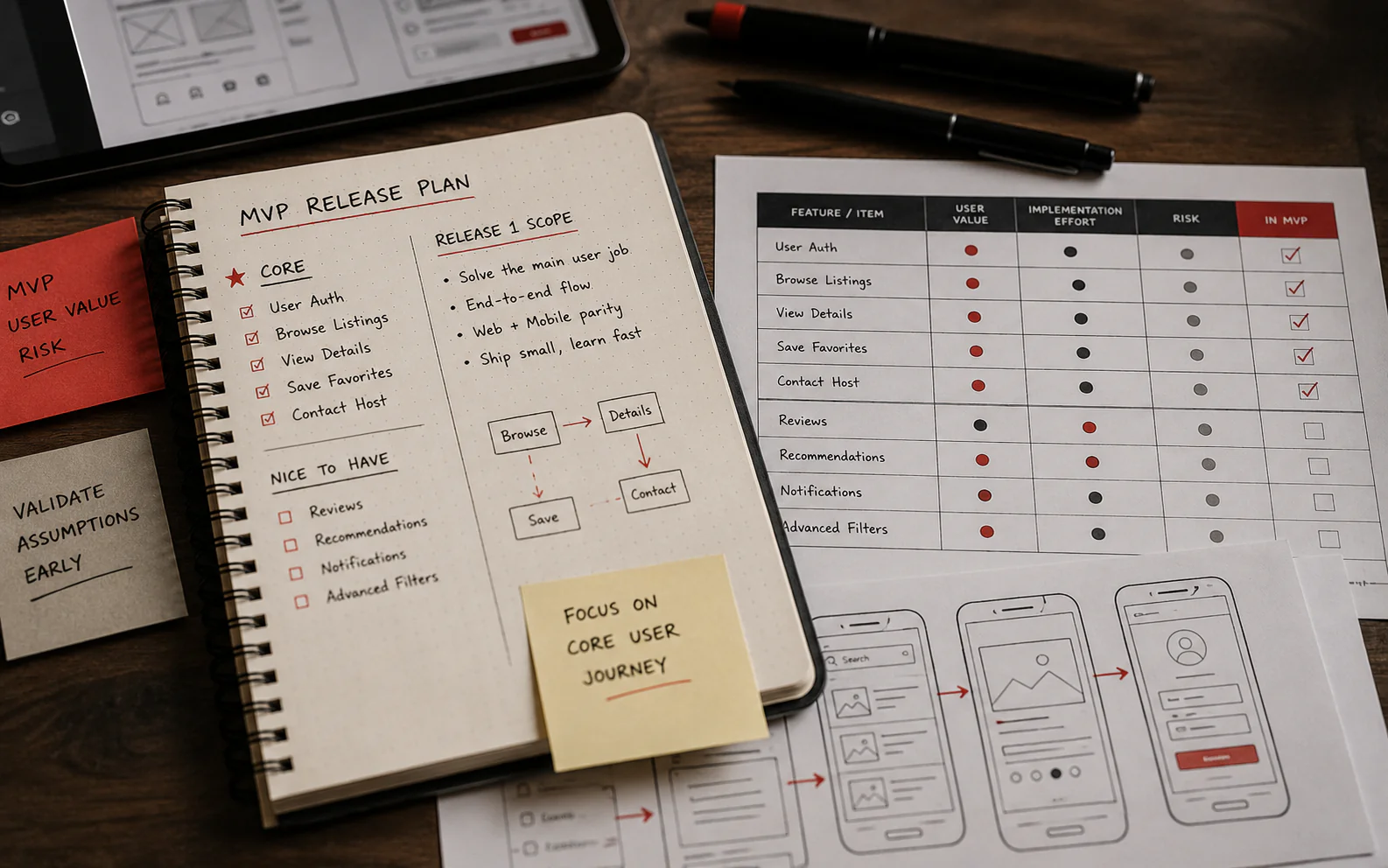
A visible prioritization matrix keeps stakeholders aligned when new requests appear. If a feature does not support the core journey in release one, capture it in phase two instead of expanding the current build.
Reviewing recent delivery work can help teams see how focused first releases are structured before scope expands.
Need help scoping release one? Discuss your MVP with iCodeLTD to review platform choice, feature priorities, and delivery plan.
SaaS Development
SaaS Data Security Basics for Startups: What Founders Should Get Right Before Launch
What founders should get right before launch: tenant data separation, per-request authorisation, login protection, secrets, webhook verification, backups, and audit records — based on OWASP guidance and Stripe docs.
Read moreAI Solutions
Is Your AI Feature Actually Working? How to Measure AI Performance After Launch
Your AI feature impressed in the demo. Here is how founders define what “working” means and measure it continuously against real usage.
Read moreProduct Delivery
Fixed Price vs Time and Materials: A Founder's Guide to Software Pricing Models
Fixed price or time and materials? Learn how each software pricing model assigns risk, when each one fits a startup project, and what your contract must include either way.
Read moreReady to review scope for AI, SaaS, web, mobile, or automation work?